
What to Do Immediately After Storm Damage Hits Your Property
Storm damage triggers a small avalanche of decisions in the first few days — most of them under stress, several of them irreversible. Get the order right and the claim closes cleanly with a fair settlement. Get the order wrong — sign with the wrong contractor, miss the carrier deadline, climb a slippery roof to take photos — and the recovery takes months longer than it should.
Here is the exact order to handle storm damage in the first 24-72 hours — what to do, what to avoid, and the door-knocking traps that cost homeowners money every storm season. Quest Exteriors has handled storm scope across the country for 30+ years; this is the playbook.
First 24 hours — safety, not assessment
The first decision after the storm passes is don't go on the roof. Roofs after a major storm are slippery from rain or hail, structurally compromised by impact damage you can't see from below, and increasingly hazardous as wet shingles separate from the deck. Roof falls during DIY post-storm "inspections" send people to the ER every storm season. The information you'd gather isn't worth the risk.
What to do instead in the first few hours:
- Check the interior for active leaks, ceiling sagging, or water staining — these dictate urgency
- Move belongings away from any active or suspected leak path
- Place buckets or tarps under active interior leaks to limit secondary damage
- Do not turn on light fixtures in rooms with active leaks — electrical hazard from waterlogged wiring
- Document interior damage with photos and video, with timestamps and rough measurements
- Stay off the roof — the documentation an insurance adjuster needs is the kind a professional inspection provides, not what you can capture by climbing up
Document everything from the ground
Ground-level documentation is genuinely useful and entirely safe. Walk the perimeter and capture photo and video evidence of:
- All four sides of the house, including soffits, fascia, and gutter condition
- Gutter dents, downspouts pulled loose, or splash-block displacement
- Granules accumulating in splash blocks or driveway runoff
- HVAC condenser fins (impact damage here strongly corroborates hail severity)
- Fence panels, vinyl siding, and any outdoor furniture or vehicles showing damage
- Tree damage — fallen limbs, broken branches still hanging, root displacement
- Neighbor properties showing similar damage (hail tracks in streaks; corroborating evidence helps)
- Date- and time-stamped photos of the damage scene before any cleanup begins
This documentation supports your claim narrative and the carrier's understanding of the event. Save everything — even photos that seem redundant become useful during supplements.
Tarp exposed areas — but call a pro
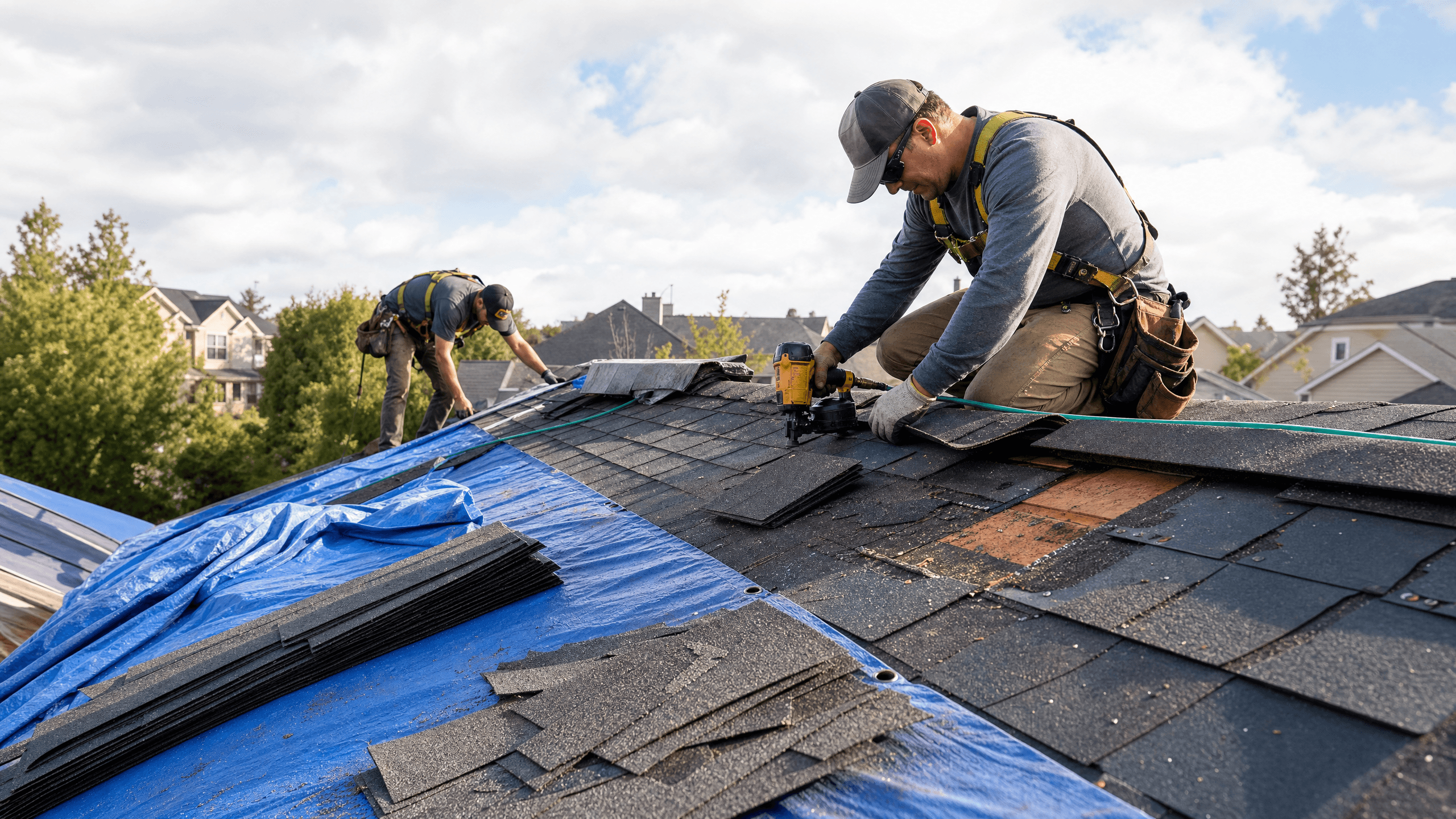
If the roof has visible breaches — missing shingles, exposed underlayment, holes — temporary tarping prevents interior damage from worsening. Do not attempt tarping yourself. Same reasoning as not walking the roof: the surface is hazardous, the tarp installation has to be done correctly to actually work, and the carrier covers professional emergency tarping under most policies.
Quest Exteriors provides emergency tarping as a same-day service after major weather events. We document the damage as part of the tarp install, photograph conditions before and after, and the tarp installation cost typically gets reimbursed by the carrier under "reasonable measures to prevent further damage" — a covered policy line item in most homeowners' policies.
Call your insurance carrier — but in the right order
Most homeowners call the carrier first. That's the wrong order. A claim opened with vague "I think I have damage" descriptions often closes with a smaller settlement than a claim opened with documentation. The right order:
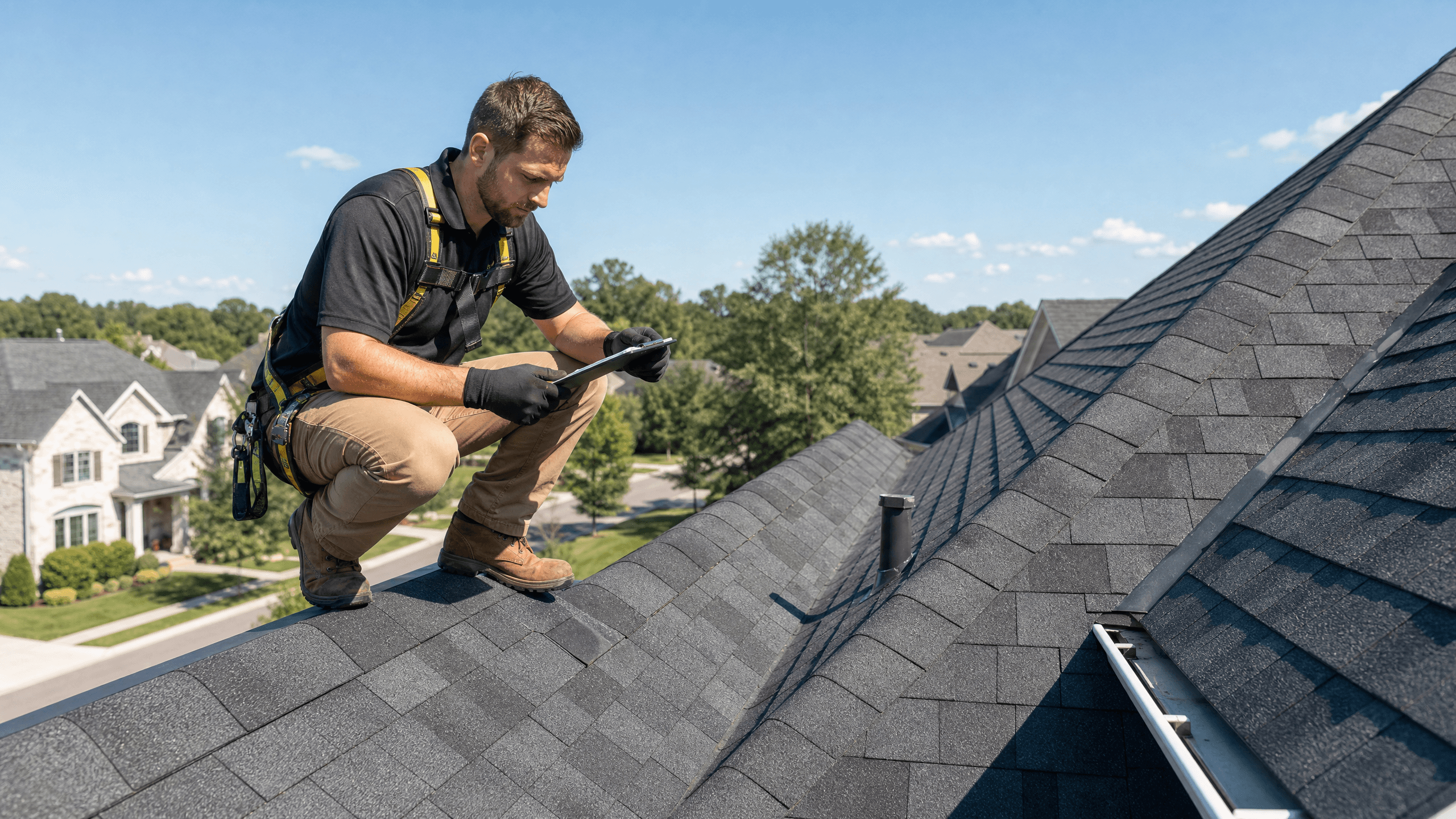
- Get a professional inspection — Quest Exteriors offers free post-storm inspections with same-day or 24-hour written reports
- Review the inspection report with the contractor to understand the damage scope and decide whether filing is worthwhile
- Call the carrier claims line (on your declarations page, not your agent) with date of loss, brief description, and confirmation that an inspection has been completed
- Schedule the adjuster meeting on the carrier's calendar — Quest meets the adjuster on-site for every Quest customer
- Review the carrier's scope after the adjuster's walk, and file supplements through Quest if the scope is incomplete
Our full step-by-step claim guide lives at How to File a Roofing Insurance Claim. The short version: documentation comes first, the carrier call comes second.
Don't sign anything from door-knockers
Within 48 hours of any major storm, out-of-state "storm chaser" contractors descend on the affected area. They knock doors, push high-pressure sign-now contracts, often write the homeowner's insurance claim themselves, and frequently disappear before warranties or supplements can be honored. The specific patterns to watch for:
- Out-of-state license plates on trucks parked in your neighborhood
- "Sign now to lock in our price" language at the door — legitimate contractors don't operate on artificial scarcity
- "We'll waive your deductible" offers — this is insurance fraud in most states, including Texas
- "Free roof" promises — legitimate contractors don't claim to make insurance pay for things insurance doesn't cover
- No local office, no year-round operation, no verifiable references — storm chasers leave the state when the storm season ends
Use a year-round, locally established, licensed contractor with verifiable references and active operations in your market. The lifetime cost of getting this wrong — a poorly installed roof that fails its warranty, a contractor who can't be reached for supplements, an insurance fraud allegation tied to your claim — is enormous.
What Quest does during emergency response
After major weather events in our service area, Quest Exteriors mobilizes regional crews for:
- Same-day emergency tarping for properties with active interior leaks or visible roof breaches
- 24-48 hour damage inspections with written reports formatted for insurance documentation
- On-site adjuster meetings for every Quest customer — every claim, every storm
- Supplement filing when carrier scopes are incomplete
- Manufacturer-spec emergency repairs for properties that can wait on full replacement
If you've had a recent severe weather event in your area, book a free inspection or call us directly — we'll be on-site for documentation within 24-48 hours and emergency tarping within the same day where access permits.